The Architecture of Luxury: The Hermès Kelly in Bambou Chèvre with Gold Hardware
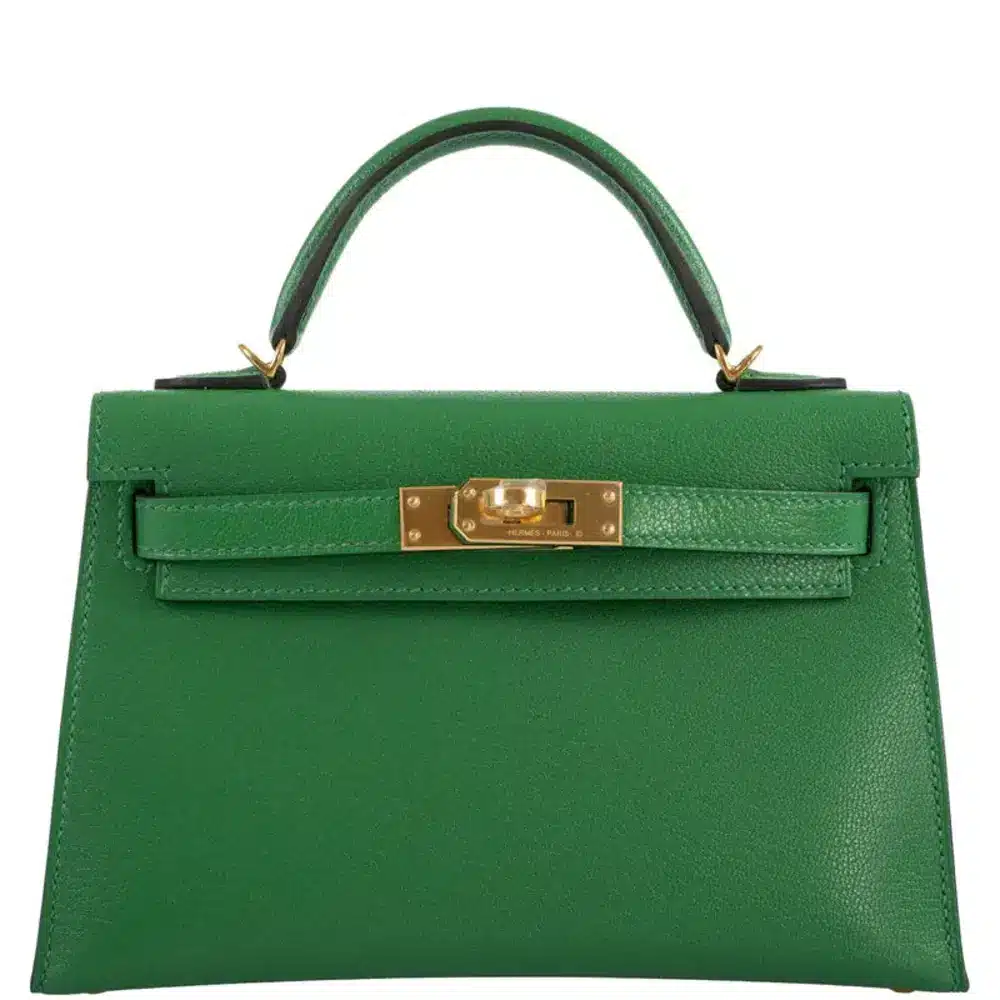
In the pantheon of luxury accessories, few items evoke the immediate reverence, mystery, and desire of an Hermès Kelly bag. While standard iterations in classic neutrals like Noir, Etoupe, or Gold command global admiration, the true upper echelon of collecting belongs to rare chromatic and material pairings.
Among these, the Hermès Kelly in Bambou Chèvre leather paired with polished gold hardware stands as a masterclass in haute couture design. It represents an intoxicating convergence of botanical vibrancy, exotic leather craftsmanship, and structural perfection.
1. The Heritage: The Evolution of the Kelly Bag
To understand the weight of this specific configuration, one must look to its lineage. Originally introduced in the 1930s as the Sac à Dépêches by Robert Dumas, the bag was quietly sophisticated until 1956.
When Grace Kelly, the Hollywood icon turned Princess of Monaco, famously used the large trapezoidal leather carryall to shield her developing pregnancy from paparazzi, the trajectory of fashion changed forever. The public instantly clamored for "Grace Kelly's bag," prompting Hermès to officially rename it the Kelly in 1977.
Every Kelly bag is a testament to slow fashion. Requiring upwards of 18 to 25 hours of meticulous hand-stitching by a single artisan, the bag is built around a rigid internal frame. Artisans utilize the traditional saddle stitch—a technique invented in the 1800s for harness making—ensuring that a single broken thread will never unravel the structural integrity of the piece.
2. The Anatomy of Exclusivity: Bambou and Chèvre Chamkila
The true allure of this specific Kelly lies in its material composition: Bambou Chèvre Chamkila leather accented by gleaming gold hardware.
The Color: Bambou
Introduced as part of Hermès' celebration of color, Bambou (Bamboo) is a striking, saturated green that mimics the fresh, vibrant stalks of a bamboo forest. Unlike darker forest greens or muted olive tones, Bambou is alive, electric, and unapologetically joyful.
In the secondary and collector markets, green Hermès bags—particularly vibrant shades like Vert Fizz, Vert Veronese, and Bambou—frequently command premiums because they are produced in far lower quantities than classic neutrals. Bambou walks a delicate tightrope between an artistic statement piece and a surprisingly versatile neutral that pops against monochromatic, earth-toned, or minimalist wardrobes.
The Leather: Chèvre Chamkila
While Hermès utilizes various hides, none capture color quite like Chèvre (goatskin). Specifically, Chèvre Chamkila is prized by connoisseurs for several distinct reasons:
The Grain and Natural Sheen: Chèvre features a distinct, tight, granular grain interwoven with a natural, subtle sheen. When light hits Bambou Chèvre leather, the iridescence of the goatskin makes the green hue appear multidimensional.
Lightweight and Resilient: Despite being exceptionally thin and lightweight, goatskin is remarkably durable. It is naturally resilient to scratches and water, making it far more practical than delicate box calfskin while maintaining a dressier profile than Togo or Clemence.
Structural Memory: Chèvre holds shape impeccably, which is crucial for the sharp, architectural lines of a Sellier Kelly.
3. The Finish: Polished Gold Hardware (GHW)
The hardware choice on an Hermès bag can dramatically alter its personality. While palladium (silver) hardware offers a modern, cool, and understated aesthetic, polished gold hardware (GHW) introduces an element of timeless warmth, regality, and vintage-inspired opulence.
The pairing of gold against the vibrant, organic shade of Bambou green is nothing short of symbiotic. It evokes nature itself: the imagery of golden sunlight filtering through a lush canopy of bamboo leaves. The thick, mirror-polished plates, the signature turn-lock (fermoir), the padlock (cadenas), and the base feet gleam with a rich luster that elevates the bag from a mere accessory to a wearable sculpture.
4. Sellier vs. Retourne: The Architectural Form
When configured in the Sellier style (which is frequently favored for Chèvre leather, especially in smaller sizes like the Kelly 25 or Mini Kelly 20), the bag features external stitching.
Crisp Edges: The panels are stitched together on the outside with a resin-sealed edge, creating sharp, geometric lines and a rigid silhouette.
Formal Elegance: A Sellier Kelly in Bambou Chèvre stands completely upright on its own, projecting an air of formal sophistication, crisp tailoring, and elite poise.
5. Investment Value and Collector Status
In contemporary luxury collecting, bags are increasingly viewed as alternative asset classes. The intersection of a rare color (Bambou), a coveted leather (Chèvre), premium hardware (Gold), and a high-demand size (such as the Kelly 25 or Mini Kelly) creates a holy grail piece for enthusiasts.
Hermès maintains strict artificial scarcity through its quota system and boutique allocation models, making direct retail purchases of specific color-and-leather combinations nearly impossible for the general public. Consequently, rare configurations like the Bambou Chèvre Kelly trade on the secondary market at significant multiples over their original retail price. They consistently outperform traditional equities, acting as a stable, liquid store of value for high-net-worth collectors.
Conclusion
The Hermès Kelly in Bambou Chèvre with Polished Gold Hardware is far more than a luxury handbag. It is a harmonious marriage of French leathercraft heritage and bold, contemporary color theory. From the rich grain of the goatskin to the blinding flash of gold against emerald-toned bamboo, every square millimeter of the bag tells a story of uncompromising quality. For the fortunate collector who secures one, it remains an eternal crown jewel—a timeless artifact of style that transcends transient micro-trends and endures as a masterpiece of design


Comments
Post a Comment